The United States Postal Service isn’t just a delivery network—it’s a 250-year chronicle of American communication, commerce, and resilience. Since 1775, it’s connected people across cities, farms, mountains, and borders. In an age dominated by digital messaging and next-day shipping, it’s worth remembering just how deep the USPS’s roots run—and how it helped build the nation.
It All Started with a Revolution
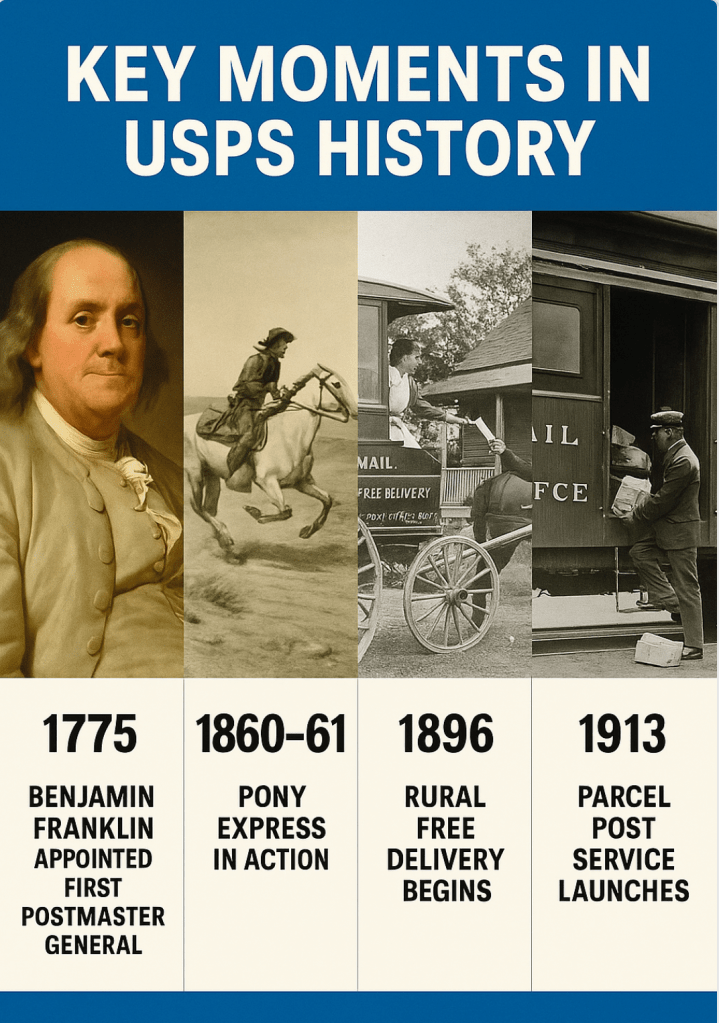
The USPS was born before the United States itself. On July 26, 1775, the Second Continental Congress appointed Benjamin Franklin as the first Postmaster General. His job: set up a system independent from British control, capable of delivering intelligence and correspondence for the colonies during the Revolutionary War. Franklin, ever the innovator, laid the foundation—streamlining routes, cutting delivery times, and introducing a network that could serve both government and citizen.
Westward, Faster
As the nation expanded westward, the mail followed. From horseback riders to stagecoaches, the USPS adapted to geography and technology. The iconic Pony Express may have only operated for 18 months (1860–61), but it proved the point: people wanted speed, and the government was willing to push the limits to deliver it.
Then came the railroads, which transformed mail delivery again—connecting coast to coast and creating the Railway Mail Service, where clerks sorted mail onboard moving trains.
Democratizing Communication
One of the most revolutionary USPS milestones came in 1896 with Rural Free Delivery (RFD). It meant Americans no longer had to travel miles to a post office to receive mail. The postal service brought the nation to their doorsteps—an early form of social infrastructure that supported isolated communities.
The introduction of Parcel Post in 1913 took things further. Farmers could ship goods directly to buyers, and families could send and receive packages affordably. It wasn’t just about letters anymore. The USPS was powering the early gig economy.
Wars, Crises, and Constant Service
Through two world wars, economic depressions, and national emergencies, the USPS kept operating. Mail service continued during pandemics, blackouts, and even in the days after 9/11. Postal workers, often unnoticed, kept routes going even when the rest of society paused.
The ZIP Code system was introduced in 1963 to keep up with the post-war population boom. That same year, the U.S. Postal Service officially replaced the old Post Office Department, transforming into a self-sustaining independent agency under the Postal Reorganization Act of 1970.
Technology, Challenges, and Reinvention
The rise of email and digital messaging hit the USPS hard, reducing the volume of first-class letters. But the growth of e-commerce gave it a new mission: package delivery. From Amazon to Etsy sellers, the USPS became an essential logistics partner—especially in rural and underserved areas where private carriers often don’t go.
At the same time, the service faced financial and political hurdles. Funding debates, pension obligations, and calls for privatization sparked controversy. Yet, when the COVID-19 pandemic hit, Americans turned to the USPS again—for medication, voting by mail, and staying connected.
Why It Still Matters
For 250 years, the USPS has been more than a delivery service. It’s a symbol of public trust and national reach. It’s one of the few institutions that touches nearly every address in the U.S., six days a week. It guarantees service regardless of profit—an idea that’s becoming increasingly rare.
The Postal Service isn’t just history—it’s infrastructure. It helped knit the U.S. together, one route at a time. And it still has a role to play in what comes next.
Fun Fact:
In 1914, a family mailed their baby (yes, a real baby) via Parcel Post to visit his grandmother. The child weighed under the 50-pound limit, and it was cheaper than a train ticket. USPS shut that loophole down quickly.
250 Years and Still Delivering
From Franklin to forever stamps, the USPS has survived revolutions, reinventions, and relentless change. As it hits its 250-year milestone, it’s not just looking back—it’s still moving forward, letter by letter, box by box, across a country that still needs what only it can provide.
 Webb Plaza
Leave a comment